What is the difference between the accrual and settled views?
The settled view is cash basis. It counts revenue and costs once the transaction has settled, built from Amazon’s settlement events and reconciled against actual payouts, which is what finance teams work from. The accrual view recognises revenue and costs when they are earned or incurred, so margin appears as soon as an order ships instead of after the settlement cycle. You switch between them at any time without re-pulling data. Both views are Amazon Seller Central.
Which channels does the profitability module cover?
A full P&L runs on Amazon Seller Central, Amazon Vendor, Walmart, Shopify, and Mirakl-powered marketplaces. Shopify margin sits beside marketplace margin on the same cost base, including in the consolidated cross-channel views. The accrual and settled views and settlement reconciliation are Amazon Seller Central. MerchantSpring connects 120+ channels in total, and bol.com profitability is in development.
Which Mirakl marketplaces are supported?
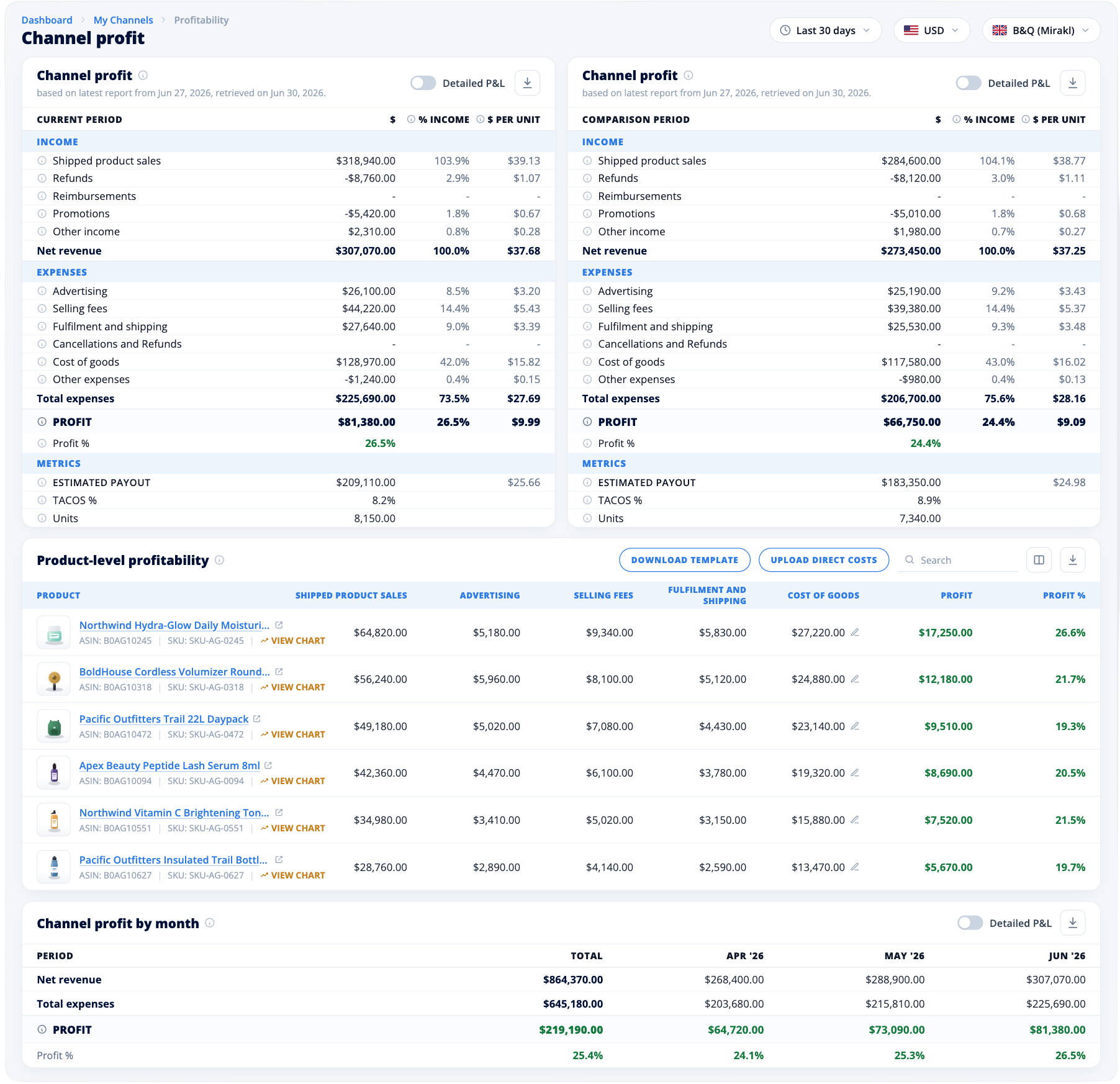
Carrefour, Macy’s, Decathlon, Leroy Merlin, Best Buy, Kroger, B&Q, Tesco and H&M, among others. P&L runs at channel, channel-group and product level, drawn directly from Mirakl’s financial APIs, with at least two years of history from activation subject to plan entitlements. If the marketplace you sell on is not on the list, support can typically add it within 24 to 48 hours.
What do Amazon Vendor accounts get?
Vendor has its own profitability module, because vendor economics run on deductions and chargebacks rather than marketplace fees. Switch between Sell-In, the inventory Amazon received, and Sell-Out, what actually sold to customers, and break margin down by brand or product to find the ASINs carrying the account. The accrual and settled views and settlement reconciliation are Seller Central.
What do I need to set up before I see a P&L?
Connect the channel, then load your costs: Cost of Goods, shipping, and whichever indirect costs you want netted in, across 25+ categories covering agency fees, content, logistics, software, consulting and operations. If you already use MerchantSpring, existing Cost of Goods data and historical effective periods migrate automatically. Up to two years of history is available, depending on your plan.
Can I pull profitability data through the API or MCP?
Yes, in both views, at store and product level. Profitability is available on the MerchantSpring API gateway and the MerchantSpring MCP server, so you can pull it into your own reporting and automations or query it from a tool like Claude or ChatGPT. Documentation is at docs.merchantspring.io.
Is my data used to train AI models?
No. Your data is not used to train MerchantSpring models, and where a request is routed to an external AI provider, it goes through terms that exclude your data from training. Every connection runs through the marketplace’s official API — Amazon’s SP-API, authorised by the account owner — and we never scrape. Query profitability through MCP and your existing user, account and channel permissions still apply: only the data needed to answer the question is returned, not an account-wide export.





.svg)

 Seller Central