Prompts and skills for marketplace reporting

Review sales, investigate a change or take a closer look at ad spend. Start with a prompt, then keep the method as a reusable skill.

New to MerchantSpring? Book a demo

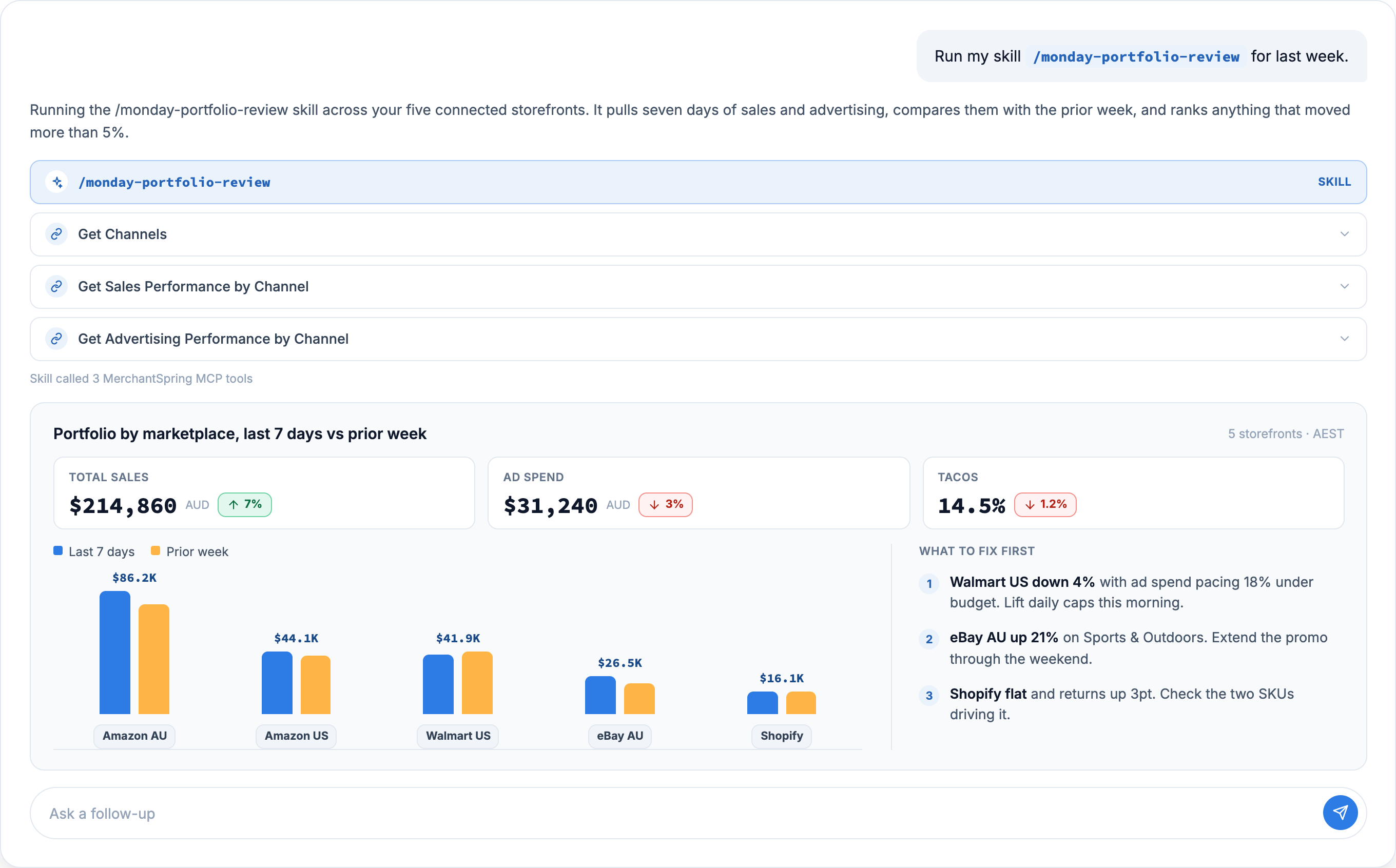
An illustrative marketplace reporting workflow using a reusable MerchantSpring skill.

Questions for your next review

Explore sales changes, product performance and ad spend. Adapt a prompt to your channels, then try it in MerchantSpring’s Insights Agent or an assistant connected through MCP.

Showing 6 of 6 workflows

See where sales are shifting

Compare weekly sales across your channels and see which accounts deserve a closer look.

By the MerchantSpring team

Prepare your weekly sales review

Bring a channel’s results, product highlights and open questions into one concise summary.

By Abhi at MerchantSpring

Find the products moving your sales

Look beyond the headline number to the products contributing most to growth or decline.

By Abhi at MerchantSpring

Make sense of your ad spend

Compare campaign spend with attributed sales and identify questions for your next review.

By Abhi at MerchantSpring

Spot keywords worth reviewing

Find keywords with spend but no reported orders, using a review threshold that suits your business.

By the MerchantSpring team

Explore what you can ask through MCP

Check the reports your connection can access, then choose a question to explore.

By the MerchantSpring team
Have a question you’d like to explore with your team?Book a demo →

See where sales are shifting

By the MerchantSpring team

Compare weekly sales across your channels and see which accounts deserve a closer look.

Make it yours

Choose the channels, or use all channels you can access. The default comparison is the last two completed weeks.

What this prompt asks for

  • A sales comparison grouped on a consistent basis
  • The largest increases and decreases in the available data
  • Any missing channels or limits on the comparison

Your prompt

Copy the prompt and replace any bracketed details with your own.

Using my MerchantSpring data, compare sales across my connected channels for the last completed Monday–Sunday week against the completed week before it.

1. Use the MerchantSpring data available in this assistant. In an external assistant, use the connected MerchantSpring MCP tools. First check whether you can access the reports this task needs. If data is unavailable, explain what cannot be answered and ask for the missing figures. Do not guess tools, fields or values, or claim you can open files or links unless this assistant supports it.

2. State the exact dates, reporting timezone, currency and sales definition. Check the tax basis where relevant. Ask if an unclear setting would change the comparison. Follow the tools’ documented date boundaries and request each period explicitly if a default comparison differs.

3. Identify the accessible channels and retrieve sales for both weeks, following all result pages. Keep channels that fell to zero in the comparison when the source confirms zero. A missing row is not evidence of zero sales. State any channels or periods that could not be checked.

4. Keep seller sales, vendor ordered revenue and other incompatible measures separate. Do not add different currencies or overlapping views of the same store. Use the returned metadata to assess overlap; similar names or totals do not prove it.

5. Within each comparable group, show prior sales, current sales, the absolute change and percentage change. When prior sales are zero, label the percentage change as undefined. Rank the largest absolute rise and fall within each group. Do not describe a partial result as a complete portfolio ranking.

Return the comparison and a short explanation of where to investigate first. Show the figures behind your explanation and flag anything that prevents a fair comparison. Read data only and do not send the results elsewhere.

A useful next question

For the channel with the largest decline in a comparable group, check whether product sales are available. If they are, show the biggest contributors and any gaps in the breakdown.

Reuse this as a skill

Download the skill, add it to an assistant that supports skills, then ask for this task with your own details. If your assistant doesn’t use skills, copy the prompt instead.

Updated 2026-09-10

Prepare your weekly sales review

By Abhi at MerchantSpring

Bring a channel’s results, product highlights and open questions into one concise summary.

Make it yours

Replace [channel] with the marketplace or store channel you want to review. The default comparison is the last two completed weeks; change the dates if needed.

What this prompt asks for

  • A weekly sales summary, with units where available
  • Product highlights where the breakdown is available
  • Open questions to take into your next review

Your prompt

Copy the prompt and replace any bracketed details with your own.

Using my MerchantSpring data, prepare a weekly sales summary for [channel]. Compare the last completed Monday–Sunday week with the completed week before it.

1. Use the MerchantSpring data available in this assistant. In an external assistant, use the connected MerchantSpring MCP tools. First check whether you can access the reports this task needs. If data is unavailable, explain what cannot be answered and ask for the missing figures. Do not guess tools, fields or values, or claim you can open files or links unless this assistant supports it.

2. Confirm the selected marketplace or store channel and the sales measure its available report uses. Use that same measure for both weeks and label it clearly, such as sales, ordered revenue or shipped revenue. Do not treat different measures as interchangeable. State the exact dates, reporting timezone, currency and tax basis where relevant. Ask if an unclear setting would change the comparison. Follow the tools’ documented date boundaries and request each period explicitly if a default comparison differs.

3. Retrieve channel sales for both weeks, plus units if returned. If compatible product sales are also available, retrieve both weeks and follow all result pages. Join periods by stable product identifiers, including products present in only one period where the report permits. Do not treat missing observations as zero. If product detail is unavailable, continue with the channel summary and say which part could not be checked.

4. Show prior sales, current sales and the absolute change, plus percentage change when prior sales are nonzero. Where product detail is available, compare its totals with channel totals only when the dates, currency, tax treatment and sales definition match. Show any gap or missing coverage. If a breakdown is incomplete, label its contributors as partial.

5. Where product detail is available, show up to five products contributing most to growth and five to decline, ranked by absolute sales change. Include current sales, prior sales and units where available. Label percentage change as undefined when prior sales are zero. Do not invent a product breakdown to complete the summary.

Return a short summary, product contributors where available and up to three questions worth investigating. Show the figures behind your explanation and flag anything that prevents a fair comparison. Do not invent causes, change account data or send the report elsewhere.

A useful next question

What does this week’s data confirm, and what should we check before deciding where to focus next? Use product detail only if available.

Reuse this as a skill

Download the skill, add it to an assistant that supports skills, then ask for this task with your own details. If your assistant doesn’t use skills, copy the prompt instead.

Updated 2026-09-10

Find the products moving your sales

By Abhi at MerchantSpring

Look beyond the headline number to the products contributing most to growth or decline.

Make it yours

Replace [channel] with your channel. The default comparison is the last two completed weeks; you can ask for different dates.

What this prompt asks for

  • The products contributing most to growth and decline
  • Before-and-after sales, with units where available
  • How much of the channel change the breakdown explains

Your prompt

Copy the prompt and replace any bracketed details with your own.

Using my MerchantSpring data, find the products contributing most to the sales change in [channel]. Compare the last completed Monday–Sunday week with the completed week before it.

1. Use the MerchantSpring data available in this assistant. In an external assistant, use the connected MerchantSpring MCP tools. First check whether you can access the reports this task needs. If data is unavailable, explain what cannot be answered and ask for the missing figures. Do not guess tools, fields or values, or claim you can open files or links unless this assistant supports it.

2. State the exact dates, reporting timezone, currency and sales definition. Check the tax basis where relevant. Ask if an unclear setting would change the comparison. Follow the tools’ documented date boundaries and request each period explicitly if a default comparison differs.

3. Retrieve product sales for both periods and channel totals if accessible on the same basis. Follow all result pages and join periods by stable product identifiers. Include products present in only one period, but distinguish missing observations from confirmed zero sales.

4. Show prior sales, current sales and the absolute change for up to five products contributing most to growth and five to decline. Include units if supplied. Rank within a consistent currency and sales definition. Label percentage change as undefined when prior sales are zero.

5. Where matching channel totals are available, compare the summed product sales with those totals for both periods and show any gap. Otherwise explain that the channel-level reconciliation could not be checked. Do not present a partial breakdown as a complete explanation of the channel change.

Summarise the largest contributors and what still needs investigating. Show the figures behind your explanation and flag anything that prevents a fair comparison. The contribution of a product does not prove why its sales changed. Read data only and do not send results elsewhere.

A useful next question

For the three products with the largest declines, separate what the data confirms from the explanations we still need to investigate.

Reuse this as a skill

Download the skill, add it to an assistant that supports skills, then ask for this task with your own details. If your assistant doesn’t use skills, copy the prompt instead.

Updated 2026-09-10

Make sense of your ad spend

By Abhi at MerchantSpring

Compare campaign spend with attributed sales and identify questions for your next review.

Make it yours

Replace [channel] with the channel whose advertising you want to review. The default comparison is the last two completed calendar months.

What this prompt asks for

  • Campaign spend and attributed sales across two months
  • Efficiency measures where the data supports them
  • The largest spend areas and questions to investigate

Your prompt

Copy the prompt and replace any bracketed details with your own.

Using my MerchantSpring data, review advertising spend and returns for [channel] for the last completed calendar month against the completed month before it.

1. Use the MerchantSpring data available in this assistant. In an external assistant, use the connected MerchantSpring MCP tools. First check whether you can access the reports this task needs. If data is unavailable, explain what cannot be answered and ask for the missing figures. Do not guess tools, fields or values, or claim you can open files or links unless this assistant supports it.

2. Confirm the selected channel and available campaign advertising reports. State the exact dates, timezone, currency, included advertising products and attribution basis. Ask if an unclear setting would change the comparison.

3. Retrieve both months with all result pages. Join campaigns by stable identifiers. Compare only compatible advertising products, date ranges and attribution definitions. Label incomplete coverage, reporting delays and missing campaigns.

4. Show campaign spend, attributed sales and their changes. Calculate ROAS and ACoS only where compatible spend and attributed sales are available with a nonzero denominator. Show clicks, impressions and CPC only if returned on the same basis. Compute totals from summed values, not averages of row-level rates.

5. Identify the three campaigns with the most spend, or fewer if fewer qualify. Show the evidence for any suggested area to investigate. Ad-attributed revenue is not profit and does not need to equal transaction sales. Do not infer an organic sales split or a TACoS figure from incompatible reports.

Return a concise campaign comparison, coverage limits and up to three useful questions. Show the figures behind your explanation and flag anything that prevents a fair comparison. Do not change campaigns, bids or budgets, or send the report elsewhere.

A useful next question

For the highest-spend campaigns, compare spend and attributed sales with the prior month. Separate what the data shows from explanations that need more evidence.

Reuse this as a skill

Download the skill, add it to an assistant that supports skills, then ask for this task with your own details. If your assistant doesn’t use skills, copy the prompt instead.

Updated 2026-09-10

Spot keywords worth reviewing

By the MerchantSpring team

Find keywords with spend but no reported orders, using a review threshold that suits your business.

Make it yours

Replace [channel]. Add a minimum spend or click threshold if you have one; otherwise the assistant should ask before making a shortlist.

What this prompt asks for

  • A shortlist that meets your chosen review threshold
  • Spend, clicks and reported orders where available
  • Coverage and attribution limits to check before acting

Your prompt

Copy the prompt and replace any bracketed details with your own.

Using my MerchantSpring data, identify advertising keywords worth reviewing in [channel] that spent money without attributed orders in the last completed calendar month.

1. Use the MerchantSpring data available in this assistant. In an external assistant, use the connected MerchantSpring MCP tools. First check whether you can access the reports this task needs. If data is unavailable, explain what cannot be answered and ask for the missing figures. Do not guess tools, fields or values, or claim you can open files or links unless this assistant supports it.

2. Confirm the selected channel and a keyword report that explicitly supplies spend and attributed orders. Do not substitute search terms, Search Query Performance, units, or an undocumented conversion field. If reported orders are unavailable, explain that this question cannot be answered from the connection.

3. State the exact dates, timezone, currency, advertising products and attribution window where documented. Flag unknown or incomplete attribution timing. Ask for a minimum spend or click threshold if I have not provided one. If I ask to see every zero-order row, label it an exploratory list.

4. Retrieve all pages within the available keyword report and deduplicate repeated records using stable identifiers. Select keywords with spend above zero, explicitly reported zero attributed orders and my chosen threshold. Missing order data is not zero.

5. Rank the shortlist by spend. Show the keyword and, where returned, campaign, ad group, match type, clicks and CPC. Show its total spend and describe the report’s coverage. Do not claim it covers all campaign spend or that zero attributed orders proves the spend was wasted.

Return the shortlist and one useful next check, with reporting and attribution limits. Do not recommend an automatic pause, create negatives, change bids or send results elsewhere.

A useful next question

For the shortlisted keywords, compare the prior completed month on the same basis and show whether the zero-order pattern persisted.

Reuse this as a skill

Download the skill, add it to an assistant that supports skills, then ask for this task with your own details. If your assistant doesn’t use skills, copy the prompt instead.

Updated 2026-09-10
Explore what you can ask through MCP

By the MerchantSpring team

Check the reports your connection can access, then choose a question to explore.

Make it yours

Name the channels you want to check, or use the channels available to your connection. The default diagnostic period is the last completed calendar month.

What this prompt asks for

  • The relevant reports exposed by your connection
  • What could be checked for your selected channels
  • Any access limits, empty reports or unresolved gaps

Your prompt

Copy the prompt and replace any bracketed details with your own.

Using MerchantSpring MCP, check what reporting data my connection can access before I choose an analysis. Use the last completed calendar month for any report checks.

1. Inspect the tools and their schemas available in this connection. Identify relevant read-only operations and their documented scope. Do not guess tool names or infer access from MerchantSpring’s dashboard, generic API documentation or marketing pages.

2. Use an available channel-listing operation to identify channels and their types if supported. If that operation is not exposed, explain the limit and ask for a channel only if another available read operation can use it. Do not infer account-wide access from a single successful report.

3. For the selected channels, check the reports exposed by the connection using limited read requests sufficient to establish access. State the exact diagnostic dates and relevant reporting settings. Do not invoke creation, upload, update or other write operations.

4. For each check, distinguish data returned, an empty response for this period, access denied, unsupported by this tool, or could not verify. Assign statuses only from the tool description or observed response. Describe a missing tool as not exposed in this connection, not as proof the product lacks the feature.

5. Suggest a workflow only when the checks support its required data. If nothing suitable is exposed, explain what could not be checked and which connection or report information is needed. Do not present a successful limited probe as proof of complete historical coverage.

Return one compact table of reports, channels and observed access, followed by a useful next step. Do not analyse business performance, change connections or settings, or send results elsewhere.

A useful next question

Which library workflow can I run with the data you actually verified, and what limits should I keep in mind?

Reuse this as a skill

Download the skill, add it to an assistant that supports skills, then ask for this task with your own details. If your assistant doesn’t use skills, copy the prompt instead.

Updated 2026-09-10

Put your prompts to work

Choose a question, add your channel and dates, and start a conversation with your data.

Inside MerchantSpring

Ask the Insights Agent about your channels, products or campaigns, then follow up on what you find.

In your AI workspace

Bring your MerchantSpring data into an MCP-compatible assistant you already work with.

Claude ChatGPT Cursor Codex Gemini CLI VS Code

For work you repeat

Keep a useful method as a skill in an assistant that supports it, and bring your own question to the next review.

See how this could fit the way your team works.

Book a demo

Prompts and skills, explained

A few answers to help you get started. Want to see what this could look like for your team?

Book a demo
What is the difference between a prompt and a skill?

A prompt starts a conversation with your AI assistant. A skill keeps a method available to reuse in an assistant that supports skills.

Where can I use these prompts?

Try an analysis prompt in the Insights Agent inside MerchantSpring, or use your preferred assistant with MerchantSpring MCP connected.

Can I adapt them to my business?

Yes. Change the channel, products, dates or question to suit the decision you’re working on.

Will you add more prompts and skills?

Yes. We’ll add examples as new features and improvements arrive. If there’s a topic you’d like us to cover, let us know.