Know what each account makes after costs.

MerchantSpring turns sales, fees, advertising, and your own cost base into a real P&L for every account you or a client runs, on Amazon Seller Central, Walmart, and Mirakl-powered marketplaces.

300+Agencies
35,000+Brands
120+Channels
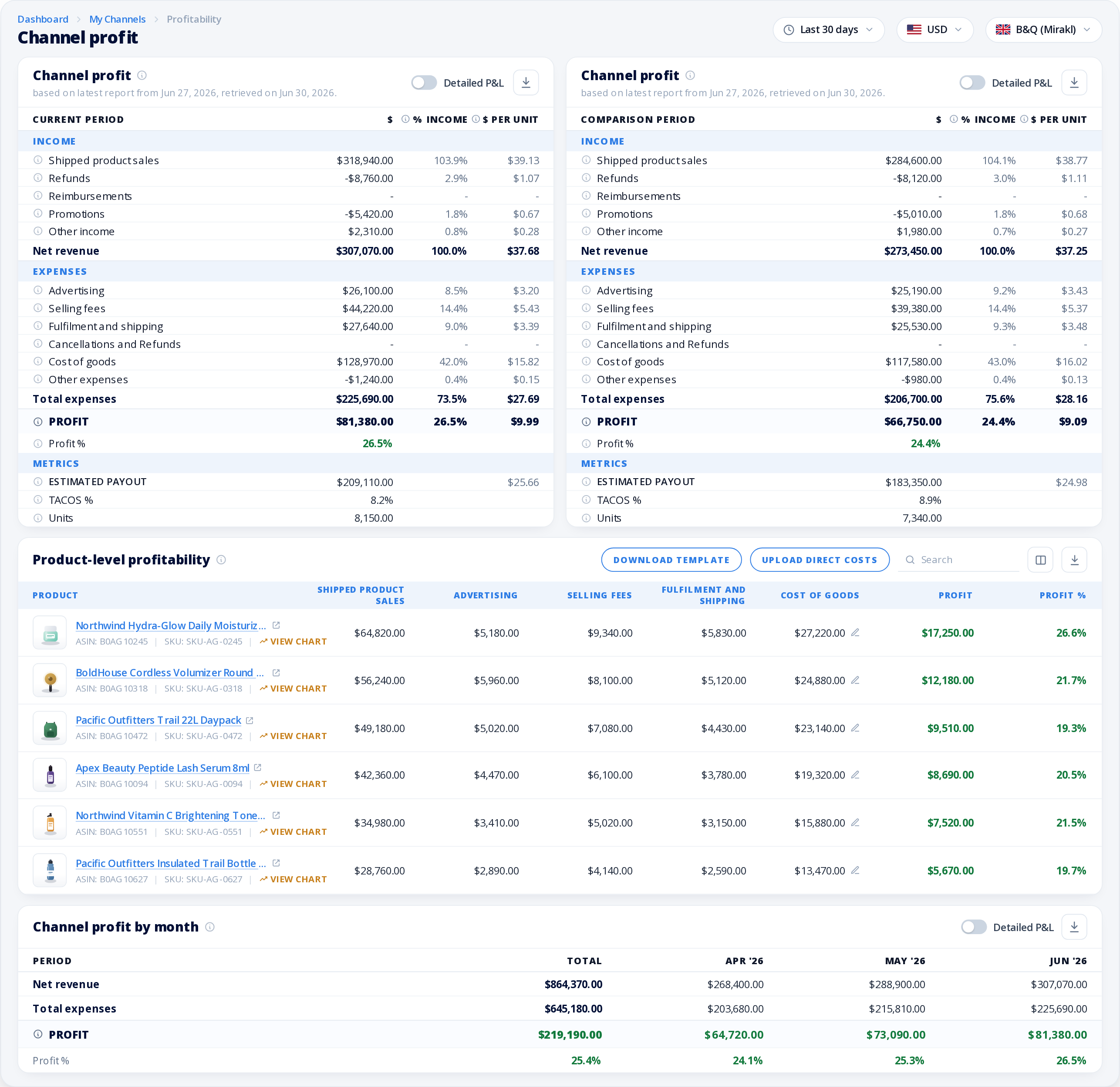
MerchantSpring profitability dashboard

The top line grows. Does your margin show it?

Marketplaces bill in fees, storage, returns, promos, and currency. The sales chart shows none of it. So the month closes, the payout lands short of the invoice, and someone spends an afternoon matching settlement files to a cost sheet that was already out of date.

Where margin goes while the top line looks fine
A marketplace fee change lands mid-month, and nothing updates to match
Returns land weeks after the sales they belong to
A stale landed cost flatters every unit sold since the last price rise
Ad spend sits in one tool, fees in another, and the P&L in neither

One place for costs. A full P&L on Amazon, Walmart, and Mirakl-powered marketplaces.

Set your landed costs per channel, since a unit can cost different amounts to land depending on where it ships from. MerchantSpring turns them into a real P&L on Amazon, Walmart, and Mirakl-powered marketplaces like Carrefour, Best Buy, and Decathlon, inside the platform that already connects 120+ of your channels.

Amazon Walmart Mirakl-powered marketplaces 120+ connected channels

From shipped order to settled payout.

Coverage depends on the capability. The accrual and cash views and settlement reconciliation run on Amazon Seller Central today. The cost base and P&L run across Amazon, Walmart, and Mirakl.

Amazon Seller Central

Two views, one switch

"What's happening now" and "what actually settled" are different questions. Stop answering both from the same export.

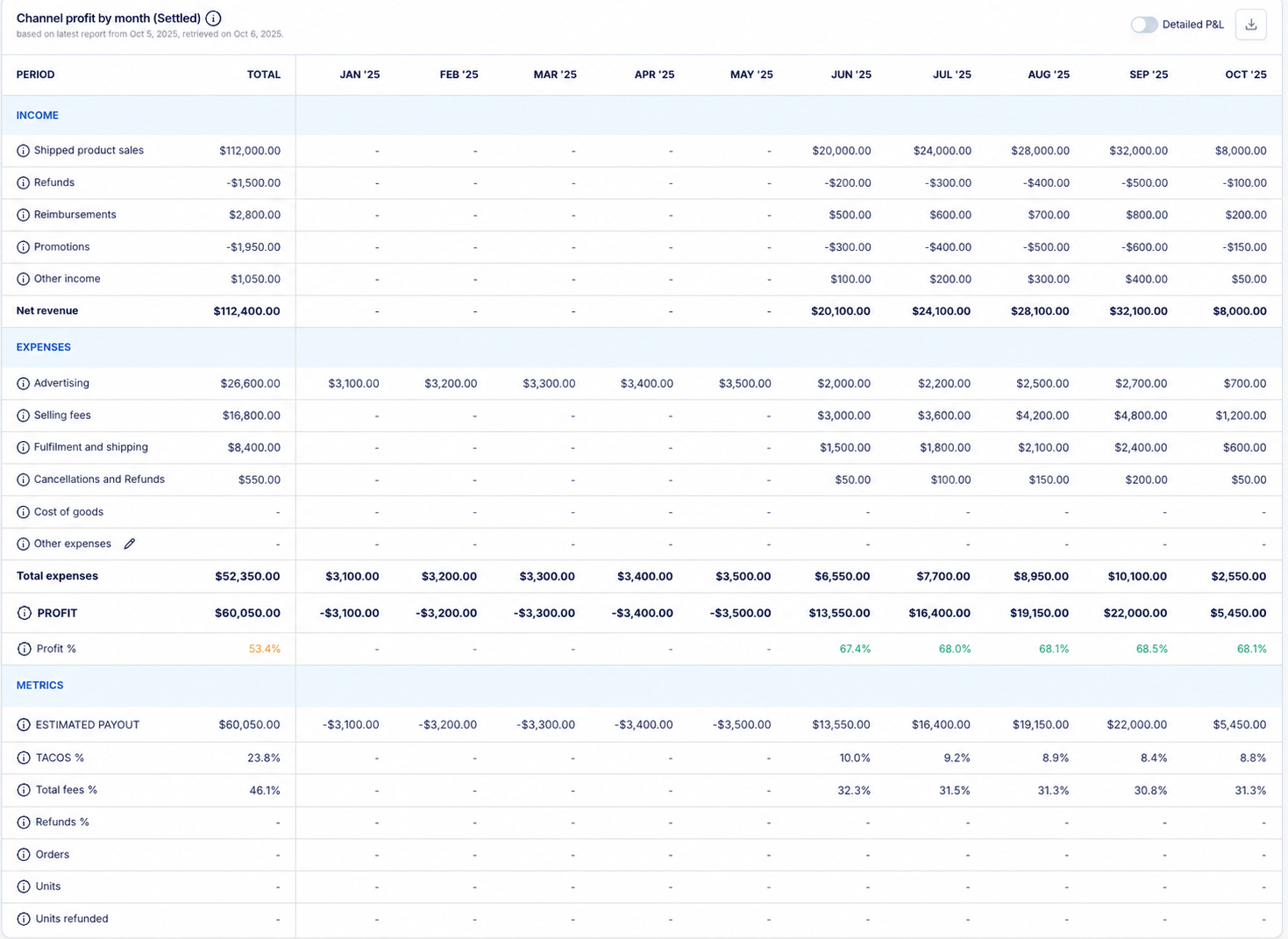
Accrual view shows profitability as soon as an order ships, ahead of the settlement cycle
Cash view builds from Amazon's settlement events and reconciles against actual payouts
Switch between them at any time, no re-pulling data
Amazon Seller Central, Walmart & Mirakl

The full cost picture

A P&L is only as honest as its cost base, and CoGS alone is not a cost base.

25+ cost categories, covering agency fees, content, logistics, software, consulting, and operations
Each cost set as a fixed dollar amount, a per-unit cost, or a percentage of revenue
Shipping and indirect costs supported alongside your Cost of Goods
Amazon Seller Central, Walmart & Mirakl

A P&L that holds up in front of finance

Industry-standard statements.

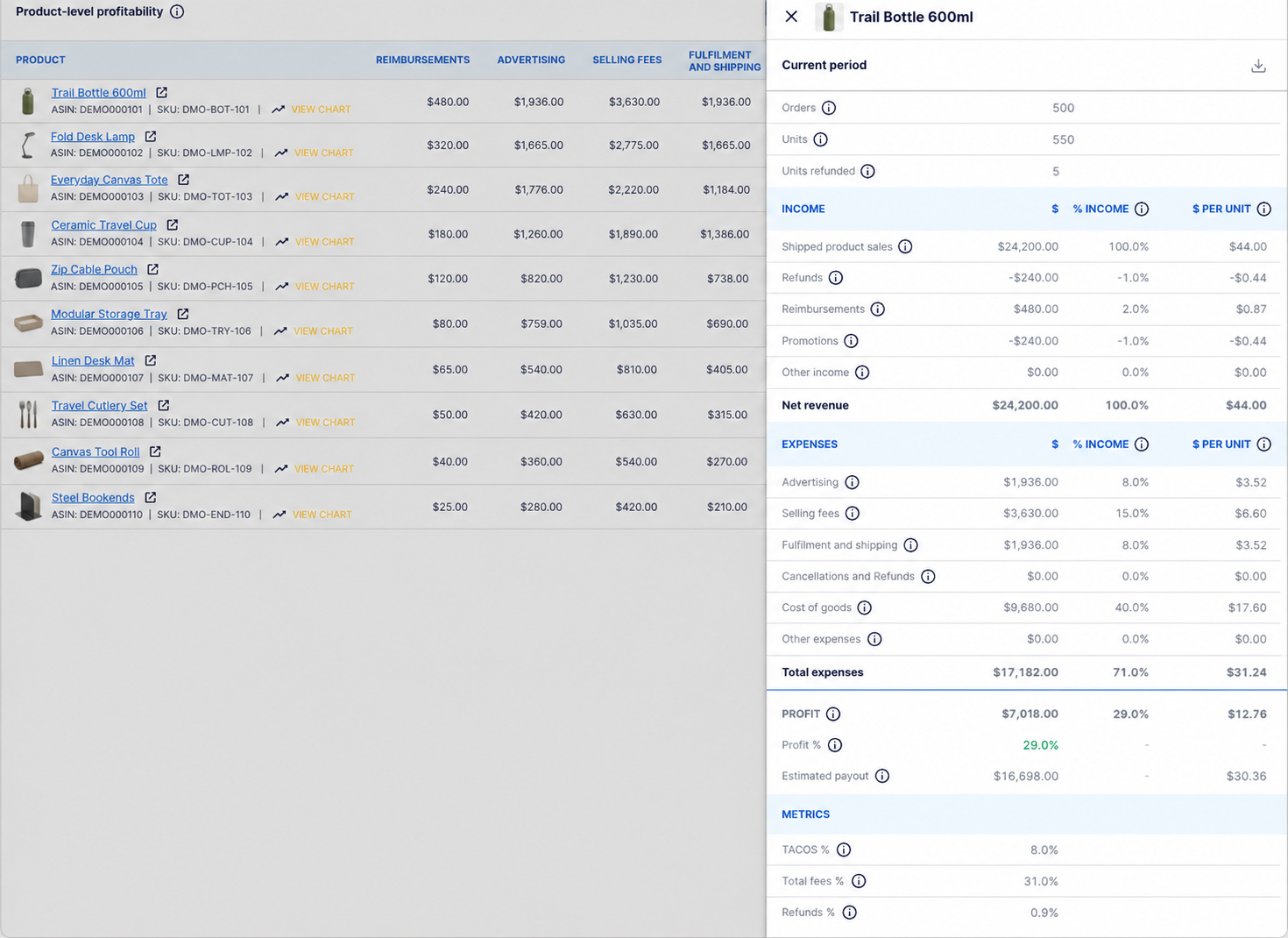
P&L at product level, seller-account level, and brand level, ready to share with an accountant or aggregator
Drill into fee-level detail, like selling fees, fulfilment and shipping, advertising, promotions, and returns
Toggle between total dollars, percentage of revenue, and per-unit economics
Amazon Seller Central

Reconciled against Amazon's own settlements

When a client asks why they should trust the numbers, "reconciled against Amazon's settlement reporting" is the whole answer.

Cash view figures tie back to settlement events and actual payouts
Margin issues surface as soon as orders ship, enough lead time to advise a client before a problem compounds
Connect Seller Accounts and run the same P&L across the lot

The demo takes 15 minutes, on data shaped like yours. Bring the client margin question that takes your team longest to answer.

Book a Demo

Margin without the month-end grind.

Pulling the numbers is easy. Reconciling them to actual payouts every month is the part that hurts.

 
Today's workflow
MerchantSpring Profitability
When margin shows up
After the settlement cycle clears, days or weeks after the orders shipped.
As soon as the order ships, in the accrual view.
Accrual and cash bases
One basis at a time, so the other question waits for a rebuild.
Both views, one switch, no re-pulling data.
Cost coverage
CoGS plus a few manual lines, updated when someone remembers.
25+ cost categories, each fixed, per-unit, or a percentage of revenue.
Payout reconciliation
Matched by hand against settlement files.
Reconciled against Amazon's settlement events and actual payouts.
Channels
One export per channel, stitched together by hand to compare.
One cost base, margin side by side across Amazon, Walmart, and Mirakl.
History
Only as far back as your own records go.
Up to two years of profitability history, depending on plan.
Access beyond the screen
Copy-paste exports.
MerchantSpring API and MCP server, the same figures the screen shows.
Reconciled against Amazon settlements
Official Amazon SP-API integrated
120+ channel integrations

The same numbers, every place you work.

Profitability is part of the data layer, not just a report screen. The reconciled figures you see on screen are the same ones your team can pull through the MerchantSpring API, or ask for through MCP in Claude or ChatGPT.

Authorised connections. Official Amazon SP-API. Customer data is not used to train AI models.

Read the docs

What's included

  • Included in all existing plans, no additional cost
  • Cost of Goods data migrates automatically
  • Historical effective periods carry over
  • Up to two years of history, depending on plan
  • On the MerchantSpring API and MCP server
  • Full P&L on Amazon Seller Central, Walmart, and Mirakl-powered marketplaces.

Frequently asked questions

The accrual view recognises profitability as soon as an order ships, so margin appears while the order is still fresh rather than after the settlement cycle. The cash view is built from Amazon's settlement events and reconciled against actual payouts, the basis finance teams use for cash flow and reporting. MerchantSpring gives you both, switchable at any time.

MerchantSpring connects 120+ marketplaces and channels. Full P&L runs on Amazon Seller Central, Walmart, and Mirakl-powered marketplaces such as Carrefour, Best Buy, and Decathlon. The accrual and cash views and settlement reconciliation run on Amazon Seller Central today.

Enhanced Profitability and its accrual and cash views cover Amazon Seller Central accounts; Vendor Central is not yet supported for these views. Amazon Vendor accounts have a separate Vendor Profitability module in MerchantSpring.

In the accrual view, profitability appears as soon as an order ships. There is no need to wait for Amazon's settlement cycle. Switch to the cash view for figures matched to actual settled payouts.

No. Existing Cost of Goods data and historical effective periods migrate automatically, so there is no need to rebuild your cost structures. From there, add any of the 25+ cost categories as you need them, each set as a fixed dollar amount, a per-unit cost, or a percentage of revenue.

Up to two years of historical profitability data is available, depending on your plan. History for existing accounts is synced ahead of launch, so there is no reset when you move onto the new engine.

Yes. Profitability data is available through the MerchantSpring API and the MerchantSpring MCP server, in both views. Pass a parameter on the request to choose the settled or deferred view; if no parameter is passed, the settled view is assumed. Pull it into your own reporting or automations, or query it from tools like Claude and ChatGPT. Documentation is at docs.merchantspring.io.

No. Profitability is included in all existing MerchantSpring plans. The amount of historical data available depends on your plan entitlements.

See it before it costs you.

Margin as soon as orders ship. Cash reconciled to the payout. One cost base across every channel a client runs. The conversation moves from what happened last month to what to do this week.

Book a demo

The demo takes 15 minutes, on data shaped like yours.