Where is growth coming from?
Compare sales across channels, countries, brands, product groups, and individual products without rebuilding the portfolio in a spreadsheet.
For brand and marketplace teams selling 3P, 1P, or both. MerchantSpring brings sales, profit, advertising, and operations into one operating view across both sides of Amazon, plus Walmart, eBay, Shopify, and Mirakl-powered marketplaces.
Trusted by 35,000+ brands and agencies
The job is not to produce more dashboards. It is to know what changed, why it matters, and where the team should act next.
Compare sales across channels, countries, brands, product groups, and individual products without rebuilding the portfolio in a spreadsheet.
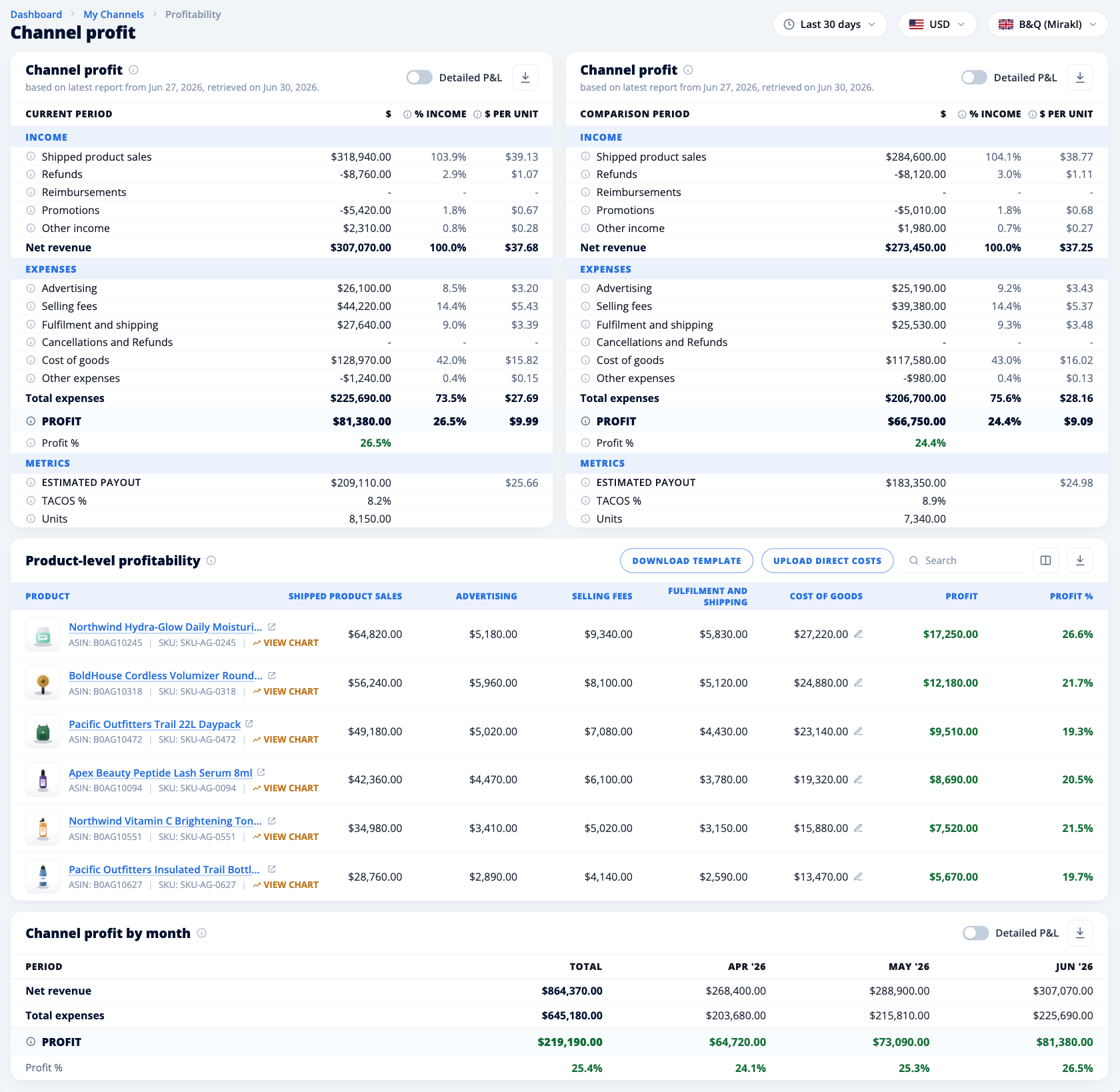
Bring fees, advertising, landed costs, shipping, and other operating costs into the same profitability view as revenue.
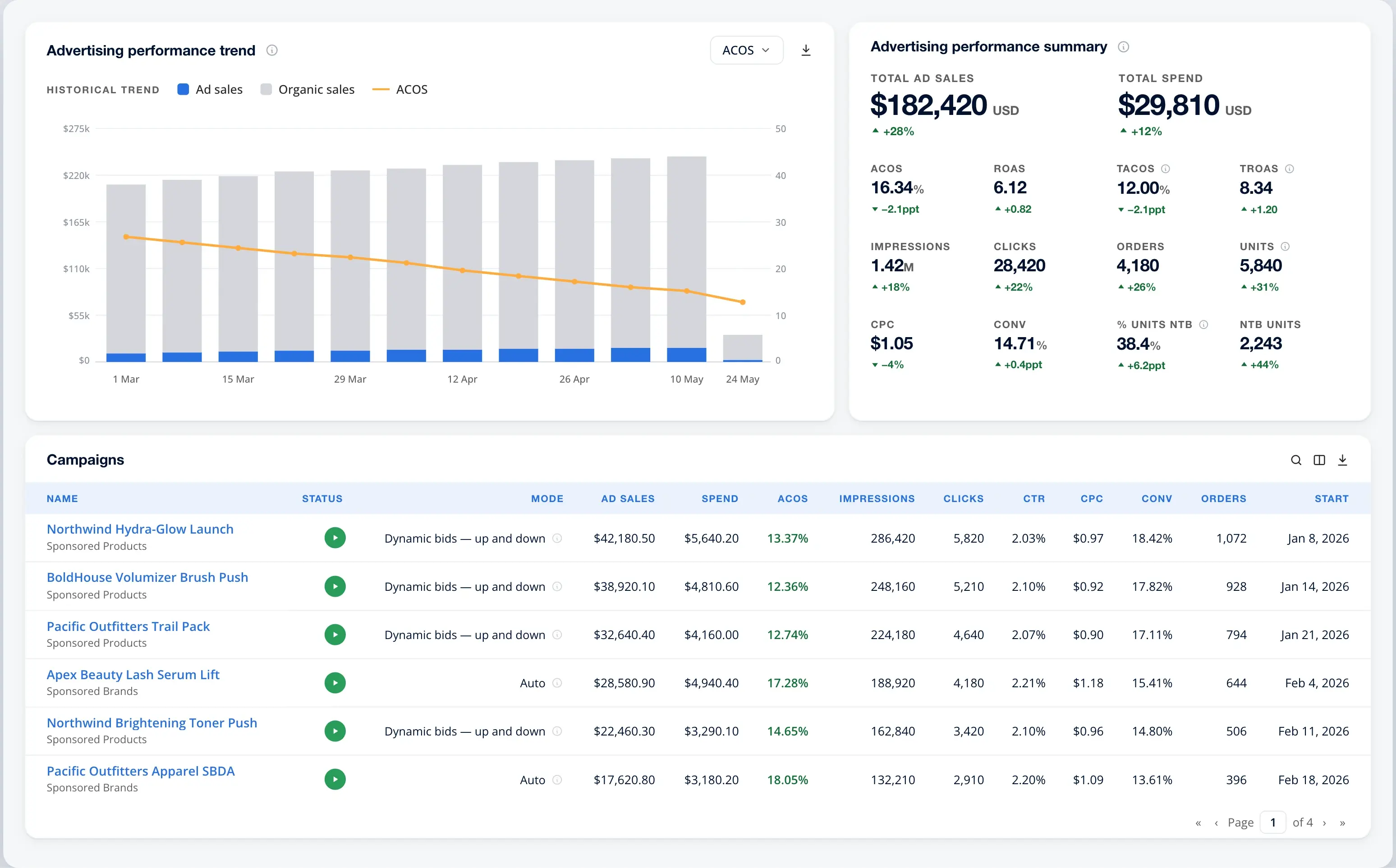
Review spend, attributed sales, ACoS, and TACoS beside product and channel performance instead of treating media as a separate business.
Watch inventory, Buy Box ownership, suppressed listings, and seller health so operational risk reaches the team before the performance review.
A combined view should make comparison easier without turning every marketplace into a mystery average. Move from the whole business to the original channel context when a figure needs explaining.
See accounts, channels, countries, and currencies together, so regional teams and headquarters work from the same numbers.
Compare brands, categories, and custom product groups using the structure your team already manages.
Inspect product, ASIN, or SKU performance where the connected source and report support that level of detail.
Return to channel-specific measures and reporting logic when reconciliation requires the original context.
Profit shows up as soon as an order ships, and a cash view reconciles it against what the marketplace actually paid out. Real margin, not just the top line.
Amazon Seller Central: accrual and cash views, with cash figures tied to settlement events and actual payouts.
Amazon, Walmart, and Mirakl-powered marketplaces: cost-base and P&L coverage. Review profitability coverage
Most tools stop at Seller Central. MerchantSpring connects Vendor Central alongside it, so teams selling 1P stop reconciling a second version of Amazon by hand.
Profitability views built for how 1P revenue is actually recognised, not a seller report with the labels changed.
Standard POs and Direct Fulfillment (DF) orders are tracked in the same place, so dropship volume never disappears from the plan.
When a listing comes down, the team hears about it when it happens, not at the weekly review.
Vendor coverage applies to Amazon Vendor Central.
Everything this page shows lives in one data layer with three doors. New data ships to all three from day one.
The operating view your team works in. Portfolio to source report, on screen.
A JSON API for BI and data teams. The same data, shaped for the warehouse and the dashboards you already maintain.
Ask questions in Claude or ChatGPT and get answers from your connected accounts, not from a model's memory.
MerchantSpring MCP works with
Authorised, non-scraping connections. Your data is not used to train AI models.
Review securitySome decisions need an answer in the meeting. Others need the same view landing in inboxes on time. Both start from the marketplace data already connected to MerchantSpring.
Use plain English to investigate connected marketplace performance, then narrow the question to the product tag, date range, or channel that matters. It answers with "your data shows", not "I think".
Keep leadership and channel teams informed without rebuilding the same export every reporting cycle.
Operational problems do not wait for the weekly report. Bring channel-level exceptions into the same operating rhythm as sales and profit.
Find listings that have lost visibility and need content, policy, or compliance attention.
Review whether price, availability, or fulfilment could be putting revenue at risk.
See stock risk around the products carrying the plan before availability becomes the constraint.
Keep account-level performance and policy signals visible alongside the commercial view.
Notification availability varies by channel. Teams can manage settings by channel and apply email frequency individually or across the portfolio.
MerchantSpring is a marketplace analytics and data infrastructure platform for brand, ecommerce, and marketplace teams. It connects the accounts you sell through, seller and vendor, and turns them into one operating view for sales, profit, advertising, and operational alerts, with the same data available through the MerchantSpring API and MCP server.
Yes. Vendor Central connects alongside Seller Central. That includes a vendor P&L with sell-in and sell-out views, purchase orders and Direct Fulfillment orders tracked together, and vendor suppression notifications. Vendor coverage applies to Amazon.
Seller and vendor accounts connect into the same MerchantSpring workspace and sit in the same portfolio structure, so one team can run both without switching tools. Each account type keeps the reporting context its channel provides.
120+ channels, on authorised connections. That includes Amazon Seller Central and Vendor Central, Walmart, eBay, Shopify, MercadoLibre, TikTok, and Mirakl-powered marketplaces. The full list lives on the channels page.
An accrual view recognises profit as soon as an order ships, and a cash view reconciles against settlement events and actual payouts. You configure 25+ cost categories as fixed amounts, per-unit costs, or a percentage of revenue. Accrual and cash views apply to Amazon Seller Central, with cost-base and P&L coverage on Amazon, Walmart, and Mirakl-powered marketplaces. Exact history and detail depend on the channel and plan.
Yes. The MerchantSpring API is a JSON API built for BI and warehouse work, and the MerchantSpring MCP server connects your accounts to AI tools like Claude and ChatGPT. Generate an API key from Settings in MerchantSpring, then start at docs.merchantspring.io.
No. Connections are authorised and non-scraping, AI answers are grounded in your own connected data, and your data is not used to train AI models. The security page covers hosting, organisation isolation, encryption, and access controls.
Channels take time to sync after they connect. Connecting sooner starts the sync sooner.
Show us the accounts, channels, and reporting rhythm your team manages. We will map the operator view to the sources and workflows that matter.
How many brands, accounts, and channels are in scope?
Which decisions still depend on manual exports?
Where do margin or operational issues surface too late?
Tell us how your marketplace team runs the portfolio today. First demos run on demo data, so bring the question that takes your team longest to answer.
MerchantSpring is the leading marketplace data platform for Enterprise Brands, Agencies and Developers - powering dashboards, APIs, and AI across 120+ channels.